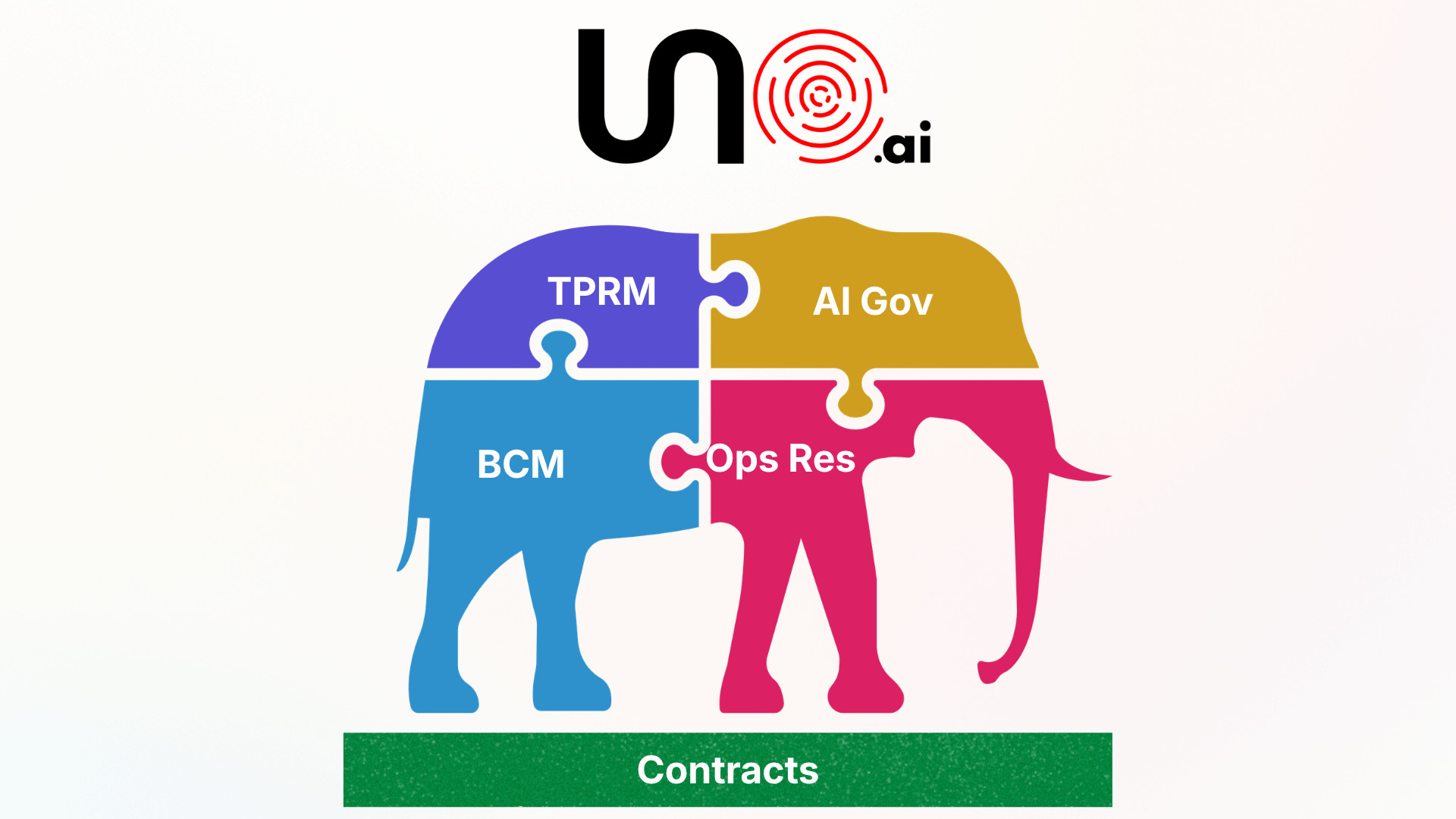
Third-party risk, business continuity, operational resilience, AI governance, and contractual obligations aren't five separate programs. They're five views of the same problem. Uno is the first platform that treats them that way — one fabric, one controls library, one audit trail, one source of truth.
The CrowdStrike incident of July 2024 showed the old model was broken. But the real threat isn't servers going down — it's AI systems producing wrong outputs, vendors with opaque nth-party AI dependencies, and failure modes that don't show up on traditional vendor risk registers or SOC 2 reports.
TPRM can't be isolated from AI governance — most vendors ARE AI systems now. BCM can't be isolated from TPRM — failures aren't "vendor offline" but "model quietly destroying trust over six weeks." AI governance IS resilience IS vendor management IS continuity. Uno treats them as one.
Autonomous vendor assessment that goes beyond the SOC 2. See the AI systems your vendors depend on, the models inside those systems, and the actual behavior of AI-powered surfaces in production.
Continuity planning for the failure modes that actually matter now — not just "vendor offline" but model drift, grounding degradation, silent behavior changes, and cascading AI-chain failures.
Real-time visibility into the critical business services your vendors support, the AI workflows underneath, and the contractual obligations that define who owes what when something breaks.
Govern every AI model, agent, and embedded-AI service across your vendor ecosystem. Monitor for drift, bias, hallucination, and misuse with the AI Nerve Center.
Live contract intelligence tied to your vendor risk, resilience, and AI governance programs. When a model deprecation hits, know immediately which contracts are affected and what remediation is required.
Pull up any vendor and see SOC 2, contract terms, AI dependencies, resilience posture, observed AI behavior, and governance status in a single integrated view. No working groups needed.
These aren't five risk programs. They're five views of the same risk program, and the organizations that keep treating them separately are going to keep being surprised.